- Home
- Tree Service
Tree Service in California: What It Includes, Laws & Costs (2026)
Do you need a licensed contractor for this?
Yes, always
Tree removal, pruning, stump grinding and cabling are contracting by law.
Look for a C‑49 Tree and Palm license (older: C‑61/D‑49); C‑27 Landscaping may also do this.
Details and sources
Exception: a gardener's incidental pruning of trees under 15 ft.
We list tree service only for contractors with a clear CSLB license.
Pick your county
- Lower
- Moderate
- Highest
All 58 counties
- Alameda27
- Alpine2
- Amador7
- Butte20
- Calaveras17
- Colusa1
- Contra Costa27
- Del Norte1
- El Dorado37
- Fresno14
- Glenn1
- Humboldt8
- Imperial2
- Inyo3
- Kern12
- Kings3
- Lake12
- Lassen3
- Los Angeles213
- Madera8
- Marin26
- Mariposa1
- Mendocino20
- Merced6
- Modoc1
- Mono3
- Monterey17
- Napa17
- Nevada44
- Orange32
- Placer55
- Plumas5
- Riverside20
- Sacramento30
- San Benito2
- San Bernardino29
- San Diego37
- San Francisco5
- San Joaquin15
- San Luis Obispo13
- San Mateo24
- Santa Barbara21
- Santa Clara30
- Santa Cruz13
- Shasta15
- Sierra2
- Siskiyou5
- Solano11
- Sonoma58
- Stanislaus14
- Sutter3
- Tehama6
- Trinity3
- Tulare15
- Tuolumne8
- Ventura18
- Yolo8
- Yuba5
What the work includes
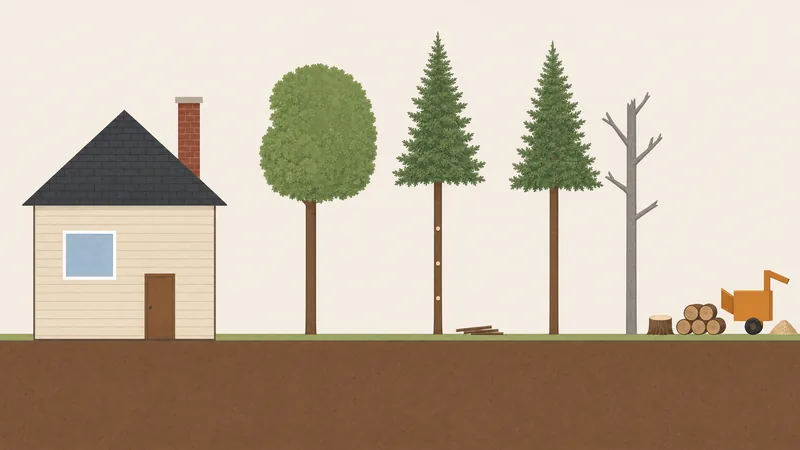
- Hazard and dead tree removal
- Limbing up lower branches to remove ladder fuels
- Crown thinning and spacing between trees
- Clearing any portion of a tree within 10 feet of a chimney or stovepipe outlet
- Chipping, log removal and stump grinding
Illustration, not to scale
What it costs
- per tree
What moves the price
- Height
- Condition
- Proximity to structures
- Simple drop in open groundBaseline
- Hazard removal rigged over a houseSeveral times the cost
- Some county Fire Safe Councils run free chipper programs for the slash
What the law requires
- PRC 4291 10 ft Tree portions within 10 feet of a chimney or stovepipe outlet must be removed Defensible space inspections
- PRC 4291 No dead wood Trees next to structures kept free of dead or dying wood; roof clear of leaves and needles
- AB-38 At sale Dead tree removal is a common pre-sale compliance item AB-38 at home sale
Tree service: laws and costs
Wildfire-focused tree work removes the fuels that carry fire into the canopy and onto the roof: dead and dying trees, low limbs, and branches overhanging the home. PRC 4291 specifically requires keeping trees near structures free of dead wood and keeping branches clear of the chimney.
California laws that require it
PRC 4291 addresses trees directly: portions of trees within 10 feet of a chimney or stovepipe outlet must be removed, trees adjacent to structures must be kept free of dead or dying wood, and the roof must be kept clear of leaves and needles. Dead tree removal is also a common line item in AB-38 pre-sale compliance.
Related guides: AB-38 at home sale · Defensible space inspections · Zone 0 · Wildfire Prepared Home · 2026 wildfire laws
What it costs
Tree work prices per tree, driven by height, condition and proximity to structures — a hazard removal that requires rigging over a house costs several times a simple drop in open ground. Some county Fire Safe Councils run free chipper programs that take the cleared slash, which trims disposal cost.