- Home
- Defensible Space
Defensible Space in California: What It Includes, Laws & Costs (2026)
Do you need a licensed contractor for this?
It depends
Hand clearing of brush, grass and ladder-fuel shrubs needs no license.
Ask for a license (C‑49, C‑27) when the job includes removing trees, pruning trees 15 ft or taller, stump grinding, or grading with a dozer/tractor (A, C‑12, C‑27).
Details and sources
This is a hint for when to ask, not legal advice.
Pick your county
- Lower
- Moderate
- Highest
All 58 counties
- Alameda24
- Alpine3
- Amador15
- Butte42
- Calaveras20
- Colusa2
- Contra Costa32
- Del Norte1
- El Dorado55
- Fresno4
- Glenn6
- Humboldt13
- Imperial4
- Inyo2
- Kern9
- Kings1
- Lake10
- Lassen5
- Los Angeles101
- Madera5
- Marin50
- Mariposa4
- Mendocino24
- Merced4
- Modoc3
- Mono3
- Monterey15
- Napa28
- Nevada82
- Orange25
- Placer57
- Plumas9
- Riverside30
- Sacramento18
- San Benito3
- San Bernardino16
- San Diego45
- San Francisco3
- San Joaquin4
- San Luis Obispo11
- San Mateo13
- Santa Barbara17
- Santa Clara26
- Santa Cruz23
- Shasta31
- Sierra5
- Siskiyou8
- Solano4
- Sonoma68
- Stanislaus6
- Sutter4
- Tehama19
- Trinity4
- Tulare4
- Tuolumne19
- Ventura17
- Yolo4
- Yuba6
What the work includes
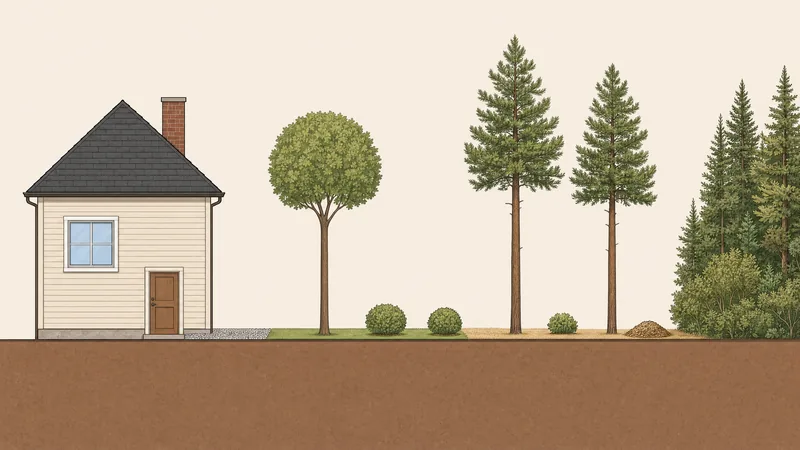
- Zone 0 · 0–5 ftBare or non-combustibleStill in rulemaking
- Zone 1 · 0–30 ftLean
- Zone 2 · 30–100 ftReduced
- Removing dead plants, grass and weeds within 100 feet of structures
- Thinning and spacing shrubs and tree crowns to break up continuous fuel
- Clearing branches away from the roof and chimney
- Zone-by-zone fuel reduction: bare or non-combustible Zone 0, lean Zone 1, reduced Zone 2
- Chipping or hauling away the cleared material
Side view · illustration, not to scale
What it costs
What moves the price
- Lot size
- Slope
- How overgrown
- Annual maintenance of a compliant lotA fraction of it
- First-time clearance of neglected acreageCan run into the thousands
- Quoted after a site visit or photos — exact bids over the phone are rare
What the law requires
- PRC 4291 100 ft Defensible space around any structure in a fire hazard area, or to the property line Defensible space inspections
- AB-38 At sale Sellers in High or Very High Fire Hazard Severity Zones must document compliance AB-38 at home sale
- Zone 0 0–5 ft Ember-resistant standard for the first 5 feet around homes Still in rulemaking Zone 0
Defensible space: laws and costs
Defensible space is the buffer of managed vegetation around a building that slows an approaching wildfire and gives firefighters room to work. California Public Resources Code 4291 requires 100 feet of defensible space around structures in fire hazard areas, organized into Zone 1 (0–30 ft) and Zone 2 (30–100 ft); a new ember-resistant Zone 0 (0–5 ft) standard is still in state rulemaking.
California laws that require it
PRC 4291 is the core requirement: 100 feet of defensible space (or to the property line) around any structure in a fire hazard area. AB-38 makes it bite at sale time — the seller of a home in a High or Very High Fire Hazard Severity Zone must provide documentation of defensible space compliance. A pending Zone 0 rule — still in state rulemaking — would add an ember-resistant standard for the first 5 feet around homes on all State Responsibility Area land, plus locally designated Very High zones on local responsibility land.
Related guides: AB-38 at home sale · Defensible space inspections · Zone 0 · Wildfire Prepared Home · 2026 wildfire laws
What it costs
Price depends on lot size, slope and how overgrown the parcel is. Annual maintenance of an already-compliant lot is a fraction of a first-time clearance of neglected acreage, which can run into the thousands. Nearly all contractors quote after a site visit or photos — exact bids over the phone are rare.