In short
CAL FIRE inspects properties in the State Responsibility Area against Public Resources Code 4291; local fire agencies inspect Very High Fire Hazard Severity Zone properties under Government Code 51182. The inspector works through CAL FIRE form LE-100a and checks 100 feet around every structure. Fail, and you get a written notice and a reinspection date — then fines starting at $100, and in some counties forced clearance billed to you.
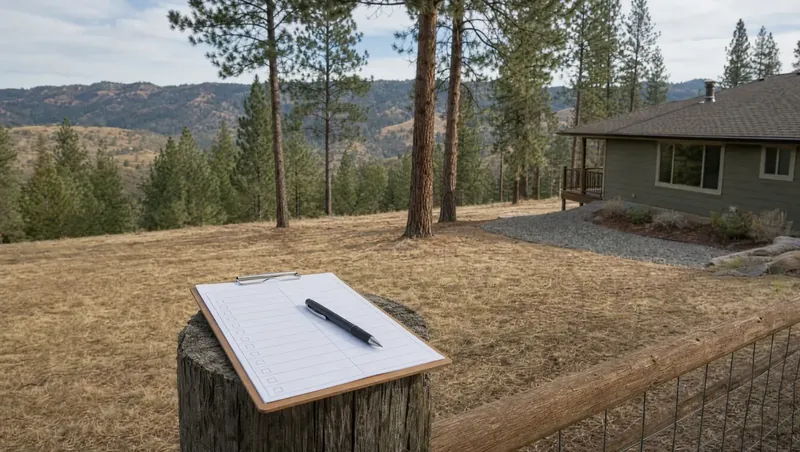
Form LE-100a: every ticked box is a fix
What the inspector checks within 100 feet of your house. Numbers on the plan match the list.
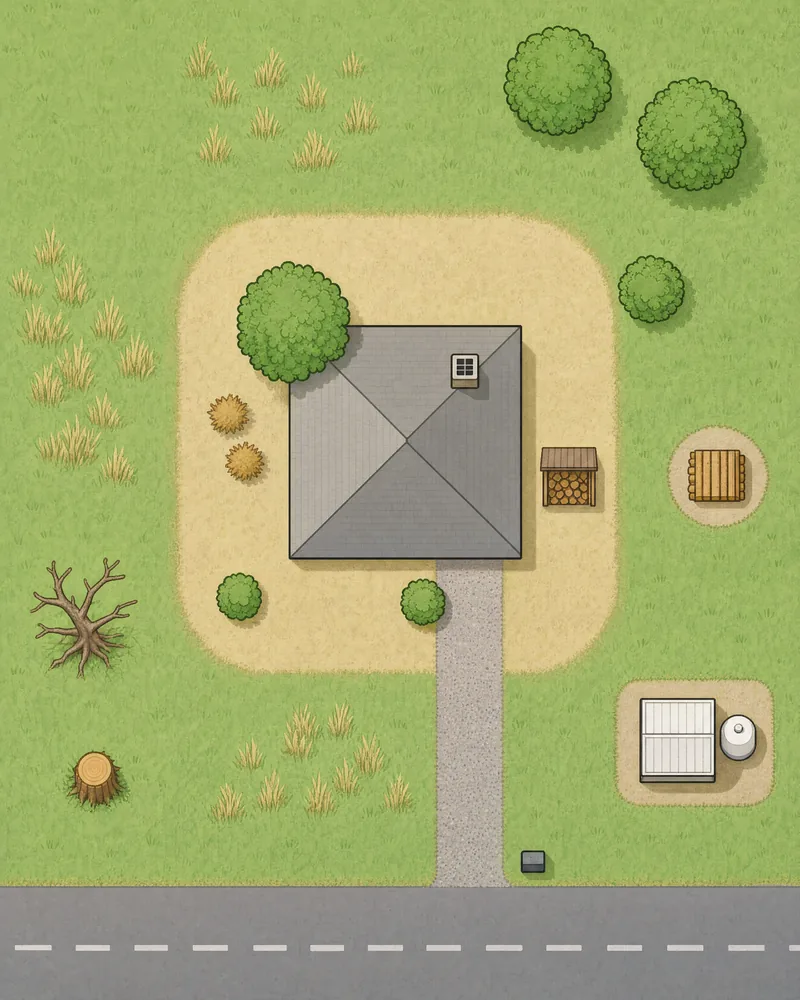
Zone 1 · 0–30 ftItems A–G
- ChimneyNo branches within 10 ft of the chimney or stovepipe outlet
- Roof and guttersClear of leaves and needles — decks, porches and stairways too
- Branches at the houseNo dead branches over the roof, by windows or against walls
- Dead plantsDead and dying grass, shrubs, leaves and needles removed
- Plant spacingVegetation separated so it interrupts a fire’s path
- Wood pileMoved out of Zone 1, unless completely covered in fire-resistant material
Zone 2 · 30–100 ftItems H–K
- GrassAnnual grasses and forbs cut to 4 inches max
- Trees and shrubsHorizontal and vertical spacing, lower tree limbs removed
- Wood pile10 ft cleared all around, down to bare mineral soil
- Dead trees and debrisRemove dead trees and fallen branches. Leaves and needles on the ground can stay if the layer is under 3 inches
Anywhere within 100 ftItems L–O
- Logs and stumpsEmbedded ones removed, or isolated from other vegetation
- Outbuildings, LPG tanks10 ft of bare mineral soil, then 10 ft with no flammable vegetation
- Address numbersContrasting colors, 4 inches minimum, readable from the street
- Chimney screenMetal screen with 3/8 to 1/2 inch openings
Zone 0 · 0–5 ft is in PRC 4291 but not on the form — LE-100a is still a two-zone form.Not enforceable yet
Who shows up, and what it costs
Spacing inspectors apply
| Slope | Shrub to shrub | Tree to tree |
|---|---|---|
| Flat · under 20% | 2× shrub height | 10 ft |
| 20–40% | 4× | 20 ft |
| Over 40% | 6× | 30 ft |
| Vertical | Limbs 6 ft off the ground · 3× shrub height to the branch above | |
If you fail
- NoticeViolations + reinspection date
- $100–$5001st infraction
- $250–$5002nd within 5 years
- ≥ $5003rd: misdemeanor · state may clear and bill you
Who gets inspected
Two separate statutes create the duty, and which one applies to you depends on who is responsible for wildfire protection where you live.
- State Responsibility Area (SRA) — Public Resources Code §4291 requires you to maintain defensible space 100 feet from each side and from the front and rear of the structure — but never beyond your property line. Fuel work on a neighbor's land requires that neighbor's written consent.
- Local Responsibility Area (LRA) — Government Code §51182 imposes the parallel duty on owners of an occupied dwelling or structure inside a Very High Fire Hazard Severity Zone designated by the local agency.
The maps that decide this are the Fire Hazard Severity Zone (FHSZ) maps from the Office of the State Fire Marshal. The SRA maps went into effect April 1, 2024; the LRA maps were released in four phases between February 10 and March 24, 2025. SRA land carries all three zones — Moderate, High and Very High — while LRA jurisdictions map only the Very High zone. One thing worth understanding before you argue with your map: FHSZ maps evaluate hazard, not risk. They work like flood zone maps — they describe the conditions a property sits in, not the odds of a loss at your specific address.
Local agencies may also adopt alternative practices or stricter ordinances than the state minimum. CAL FIRE cites San Diego County, which requires 50 feet of clearance in Zone 1 rather than 30. Under Gov. Code 51182(f)(2), an owner who complies with the local agency's adopted alternative practices is not treated as having violated the state section.
What the inspector checks
The working document is CAL FIRE's form LE-100a, "Notice of Defensible Space Inspection". It is a checklist of violations: any box the inspector ticks is something you have to fix. The form itself cites the legal basis — 14 CCR §1299.03, PRC §4291, the BOF General Guidelines, CFC §505.1 and CBC §2113.9.2.
The form is organized in two zones plus a set of general requirements. Note that the form's Zone 1 is 0–30 feet, which is wider than the 5–30 foot band the statute now describes (see the Zone 0 box below).
Zone 1 — within 30 feet of structures (items A–G)
- No branches within 10 feet of any chimney or stovepipe outlet.
- Roofs, gutters, decks, porches and stairways clear of leaves, needles and other vegetation.
- No dead tree or shrub branches overhanging roofs, below or next to windows, or up against wall surfaces.
- All dead and dying grass, plants, shrubs, trees, branches, leaves, weeds and needles removed.
- Fuels removed or separated so that vegetation spacing interrupts a fire's path.
- Exposed wood piles relocated out of Zone 1, unless completely covered in fire-resistant material.
Zone 2 — 30 to 100 feet (items H–K)
- Annual grasses and forbs cut to a maximum height of 4 inches.
- Proper horizontal and vertical spacing between shrubs and trees, with lower tree limbs removed.
- Exposed wood piles cleared 10 feet in all directions, down to bare mineral soil.
- Dead and dying trees, branches, shrubs and surface debris removed. Loose surface litter — fallen leaves or needles, twigs, bark, cones — is permitted up to a depth of 3 inches.
General requirements within 100 feet (items L–O)
- Logs and stumps embedded in the soil removed, or isolated from other vegetation.
- Outbuildings and LPG tanks: 10 feet of clearance to bare mineral soil, plus another 10 feet with no flammable vegetation around that.
- Address numbers in contrasting colors, minimum 4 inches, readable from the street or access road.
- Chimney and stovepipe openings fitted with a metal screen with openings between 3/8 inch and 1/2 inch.
The spacing numbers inspectors actually apply
"Proper spacing" is the item most owners guess at and fail. CAL FIRE publishes the figures on its defensible space page:
- Vertical: remove tree branches at least 6 feet from the ground. Between a shrub and the lowest tree branch above it, keep three times the shrub's height — a 5-foot shrub needs 15 feet of clearance to the branch above.
- Horizontal, shrub to shrub: two times the shrub height on flat or mild slope (under 20%), four times on 20–40% slope, six times on slopes over 40%.
- Horizontal, tree to tree: 10 feet on flat or mild slope, 20 feet on 20–40% slope, 30 feet on slopes over 40%.
How the inspection works
CAL FIRE and its partners conduct defensible space inspections in the State Responsibility Area, where CAL FIRE has primary responsibility for wildfire protection. The department does not need your permission to look: PRC §4119 authorizes it to inspect all properties subject to state forest and fire laws, except the interior of dwellings, for the purpose of determining compliance.
If you need an inspection on a schedule — typically for a sale — CAL FIRE takes requests through the "Real Estate Defensible Space Inspection" request form linked from fire.ca.gov/dspace. The property owner or the selling agent can request it; a buyer's agent can request it too, but needs the current owner's permission.
Cost depends entirely on who inspects. The CAL FIRE inspection is free — the Orange County Fire Authority, which points owners outside its area to CAL FIRE, states there is no cost for the inspection. County programs set their own fees. Los Angeles County charges a $151 inspection fee for 2026, billed on the 2027 property tax bill, and it is assessed on every declared hazardous property whether the owner cleared it or not. LA County's 2026 declaration covers 130,812 parcels, with inspections starting around April 1 for desert communities, May 1 inland and June 1 on the coast.
At the end of an inspection you get the form. If any boxes are checked, the notice states you are required to correct the violations listed, gives a "REINSPECTION DATE ON OR AFTER", and warns that failure to correct may result in a citation and fine. The State Fire Marshal's model defensible space inspection program describes the same sequence for local agencies: site inspections, notice of violation, timelines for corrective action and reinspection, citations requiring abatement, and an administrative appeal path.
What happens if you fail
Failing an inspection is not itself a penalty — it starts a clock. Penalties come from two directions: the state criminal ladder, and local administrative fees.
State penalties
- Under PRC §4291.1, a first violation of PRC 4291 is an infraction punishable by a fine of $100 to $500. A second conviction within five years: $250 to $500. A third within five years is a misdemeanor with a fine of at least $500 — and at that point the department may perform or contract the compliance work itself and bill the convicted owner for the cost, in which case paying those costs replaces the fine.
- If you produce verification in court, before the fine is imposed, that the condition behind the citation no longer exists, the court may reduce the fine to $50.
- Government Code §51185 sets the identical ladder — $100–$500, then $250–$500, then misdemeanor on a third violation within five years — for Gov. Code 51182 in Local Responsibility Areas.
- Government Code §51186 is the forced-abatement route: the local agency notifies the owner, and if the work is not done the agency may have the corrections made, with the expenses becoming a lien on the property. Where a local defensible space program has been adopted, the enforcing agency may recover the actual cost of abatement and record a notice of abatement lien.
County fee schedules, in practice
The state fines are not what most owners actually encounter. County administrative fees are, and they stack:
- Los Angeles County: parcels still non-compliant after the second inspection go to the Defensible Space Unit and are assessed a $500 administrative fine plus a $1,647 abatement enforcement fee. The compliance window is 30 days after the Official Inspection Report; the $1,647 lands on the annual property tax bill as CO FIRE ABMT ENF. If the Agricultural Commissioner/Weights and Measures inspects or clears the parcel, a $59.07 inspection fee plus the actual cost of clearing goes on the tax bill as LA CO HAZABATE. The county notes the number of parcels that actually incur fines is traditionally minimal.
- Nevada County: fees are progressive and cumulative — $130 assessed on a non-compliant third inspection, $700 on the fourth, $1,300 on the fifth; after the fifth, the case may be referred to Code Enforcement for abatement. The timeline: at least 30 days after the Notice to Abate is mailed, then a second inspection; if the property still lacks defensible space, a Warning Letter starts a 15-day window. Appeals must reach the Clerk of the Board within 10 days of the Notice to Abate, with the appeal fee.
Zone 0 and your inspection: the current status
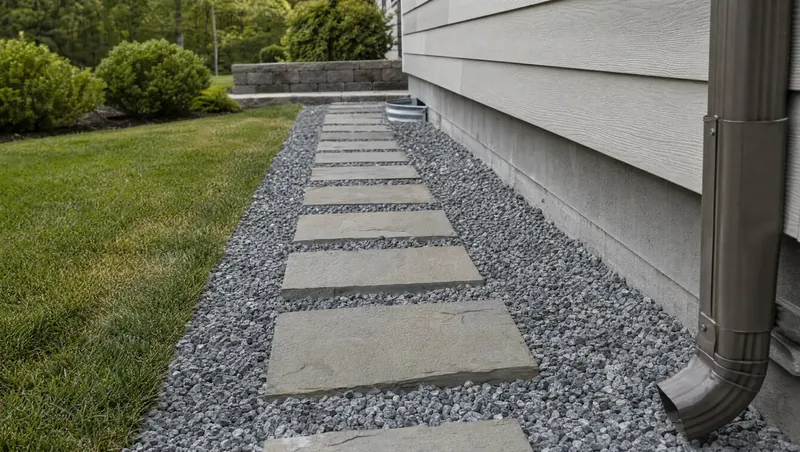
PRC 4291 already describes three levels of fuel management — an ember-resistant zone within 5 feet, more intense reduction between 5 and 30 feet, and the rest out to 100 feet — but the ember-resistant zone is not yet enforceable. The full Board of Forestry and Fire Protection approved the Zone 0 regulation on August 19, 2026; the adopted package went to the Office of Administrative Law as an emergency rulemaking (file 2026-0828-03E) and was recorded as "Withdrawn, September 8, 2026". It has not been resubmitted as of September 17, 2026. The published agenda for the Board's September 22–24, 2026 meeting contained no Zone 0 item; that meeting date has passed, and Zone 0 still has no effective date. Meanwhile PRC 4291(h) prohibits CAL FIRE from changing inspection practices and forms for Zone 0 until the State Fire Marshal issues a written finding that the Legislature has appropriated sufficient resources — which is exactly why LE-100a is still a two-zone form while the statute reads in three. Full detail: our Zone 0 guide.
How to prepare
- Self-assess first. CAL FIRE offers a readiness self-assessment tool on fire.ca.gov/dspace, and a downloadable Zone 0 Checklist (also available in Spanish). Walking the LE-100a items above with the checklist in hand finds most fail points before an inspector does.
- Work the closest zone first. Roof and gutter debris, branches within 10 feet of the chimney, dead material against walls and under windows, and wood piles inside 30 feet are the items that appear on nearly every notice.
- Do the cutting safely. CAL FIRE's guidance is to mow before 10 a.m. and never on a hot or windy day, and it notes string trimmers are safer than lawnmowers for clearing vegetation.
- Check the license if you hire out. Counties do not endorse vendors — Nevada County's Office of Emergency Services states it cannot recommend a defensible space vendor, but advises confirming any vendor holds a valid state license from the Contractors State License Board (CSLB).
That last point is why this directory exists: listings here are built from public records, including CSLB license data where a license is on file. Browse defensible space contractors for the zone-by-zone clearing and spacing work, or brush clearing services for heavier fuel loads in Zone 2.
Selling your home?
A sale adds a second, independent requirement. AB-38 obliges sellers of homes in a High or Very High Fire Hazard Severity Zone to give the buyer documentation of defensible space compliance — which in practice means passing the same inspection described above, on escrow's timeline rather than the county's. See our AB-38 guide for the documentation rules and the fallback when there is no time to inspect before closing.
Passing an inspection is a minimum, not a credential. Owners who want something verifiable to hand an insurer or a buyer can go beyond the legal standard with voluntary certification — see Wildfire Prepared Home.
FAQ
5
How much does a defensible space inspection cost?
A CAL FIRE defensible space inspection in the State Responsibility Area is free — the Orange County Fire Authority, which refers out-of-area owners to CAL FIRE, states plainly that there is no cost for the inspection. County programs are a separate matter and set their own fees: Los Angeles County charges a $151 inspection fee for 2026, billed on the 2027 property tax bill, and it is assessed on every declared hazardous property whether the owner cleared it or not.
What happens if I fail a defensible space inspection?
You get a notice listing the violations and a reinspection date. If it stays uncorrected, a violation of PRC 4291 is an infraction with a fine of $100 to $500; a second conviction within five years is $250 to $500; a third within five years is a misdemeanor with a fine of at least $500, and at that point CAL FIRE may do the work itself and bill you instead of fining you. Government Code 51185 sets a mirror-image ladder for Very High Fire Hazard Severity Zones in Local Responsibility Areas. If you show the court the condition was corrected before a fine is imposed, the court may reduce the fine to $50.
Who inspects my property — CAL FIRE or my county?
It depends on which responsibility area you are in. CAL FIRE and its partners conduct defensible space inspections in State Responsibility Area land, where CAL FIRE has primary wildfire protection responsibility. In Local Responsibility Areas, the local agency enforces Government Code 51182 inside the Very High Fire Hazard Severity Zone it designated, and it may adopt its own ordinance, its own fee schedule, and standards stricter than the state minimum — San Diego County, for example, requires 50 feet of clearance in Zone 1.
Do I need to be home for the inspection?
Not for a standard exterior inspection. Los Angeles County states owners are not required to be home for the inspection, and CAL FIRE has statutory authority under PRC 4119 to inspect properties subject to state forest and fire laws — everything except the interior of dwellings — to determine compliance.
When does Zone 0 become part of the inspection?
No. The full Board of Forestry and Fire Protection approved the Zone 0 regulation on August 19, 2026 and submitted it to the Office of Administrative Law on August 28, 2026 as an emergency rulemaking, file 2026-0828-03E. That package was withdrawn from OAL review on September 8, 2026 and, as of September 17, 2026, had not been resubmitted. The agenda published for the Board's September 22–24, 2026 meeting contained no Zone 0 item; that meeting date has passed, so Zone 0 still has no effective date and inspectors are not citing it as a standalone requirement. Separately, PRC 4291(h) bars CAL FIRE from changing defensible space inspection practices and forms for Zone 0 until the State Fire Marshal makes a written finding that the Legislature has appropriated sufficient resources — which is why form LE-100a is still a two-zone form.
Sources 17
- Public Resources Code §4291 leginfo.legislature.ca.gov
- Government Code §51182 leginfo.legislature.ca.gov
- went into effect April 1, 2024 fire.ca.gov
- form LE-100a, "Notice of Defensible Space Inspection" readyforwildfire.org
- defensible space page fire.ca.gov
- PRC §4119 leginfo.legislature.ca.gov
- form linked from fire.ca.gov/dspace survey123.arcgis.com
- Orange County Fire Authority ocfa.org
- State Fire Marshal's model defensible space inspection program osfm.fire.ca.gov
- PRC §4291.1 leginfo.legislature.ca.gov
- Government Code §51185 leginfo.legislature.ca.gov
- Government Code §51186 leginfo.legislature.ca.gov
- $1,647 abatement enforcement fee fire.lacounty.gov
- cumulative nevadacountyca.gov
- Board of Forestry and Fire Protection bof.fire.ca.gov
- Office of Administrative Law oal.ca.gov
- Zone 0 Checklist readyforwildfire.org
Need clearance work before your reinspection date? Find contractors in your county
- Alameda44
- Alpine3
- Amador16
- Butte60
- Calaveras23
- Colusa4
- Contra Costa52
- Del Norte1
- El Dorado75
- Fresno16
- Glenn7
- Humboldt15
- Imperial5
- Inyo4
- Kern19
- Kings4
- Lake18
- Lassen7
- Los Angeles282
- Madera10
- Marin75
- Mariposa4
- Mendocino34
- Merced9
- Modoc3
- Mono5
- Monterey24
- Napa44
- Nevada97
- Orange49
- Placer86
- Plumas11
- Riverside64
- Sacramento41
- San Benito6
- San Bernardino41
- San Diego67
- San Francisco9
- San Joaquin18
- San Luis Obispo16
- San Mateo32
- Santa Barbara30
- Santa Clara49
- Santa Cruz33
- Shasta41
- Sierra5
- Siskiyou10
- Solano13
- Sonoma107
- Stanislaus16
- Sutter7
- Tehama21
- Trinity5
- Tulare17
- Tuolumne19
- Ventura34
- Yolo12
- Yuba12
 Zone 0: the first 5 feet
  AB-38: selling a home
  Wildfire Prepared Home
  Insurance discounts