- Home
- Tehama County
Wildfire Mitigation Contractors in Tehama County, CA
Tehama County in 30 secondsContractors, local rules, where to get help
21 wildfire mitigation contractors are listed for Tehama County, 12 with a clear CSLB license.
- Fire hazard zones
- Look up your address
The Board of Supervisors adopted Ordinance No. 2146 on March 18, 2025 (effective April 17, 2025), designating Moderate, High and Very High Fire Hazard Severity Zones in the unincorporated Local Responsibility Area as recommended by the State Fire Marshal (map dated January 22, 2025). Before this only Very High zones had to be adopted in the LRA. The county fire department puts the zoned LRA at about 17,808 acres Moderate, 21,030 acres High and 989 acres Very High. In High and Very High LRA zones, new buildings must meet the wildland-urban interface building code (CBC Chapter 7A) and sellers must make a natural hazard disclosure. State Responsibility Area zones took effect April 1, 2024.
- Defensible space rules
- Source
Tehama County Code Chapter 9.05 (Ordinance 2122, adopted June 2022) applies to all unincorporated land. Rural and agricultural parcels must keep firebreaks meeting Public Resources Code 4291 and Government Code 51182 (the state 100-foot defensible space rules), as must urban-zoned parcels that have buildings or exceed ten acres. Vacant urban parcels of two acres or less must be cleared across the whole lot, and vacant urban parcels of two to ten acres next to developed lots need a 30-foot firebreak along the property lines. The fire agency's chief or designee, or a county code enforcement officer, can order abatement. Owners are liable for the county's abatement and administrative costs and possibly attorney's fees, and the county can hold back permits while a notice to abate goes unresolved for more than 14 days. Tehama County Fire's inspection guide spells out the work: grass and weeds cut to 4 inches or less inside the firebreak, trees trimmed 6 feet up from the ground, shrubs spaced at least three times their widest diameter and kept 10 feet from buildings, branches cut back 10 feet from chimneys and stovepipes, and leaves and needles cleared off roofs, gutters and decks. Irrigated agricultural parcels can be exempt from the 100-foot firebreak if they are not a nuisance.
- Chipping
- Source
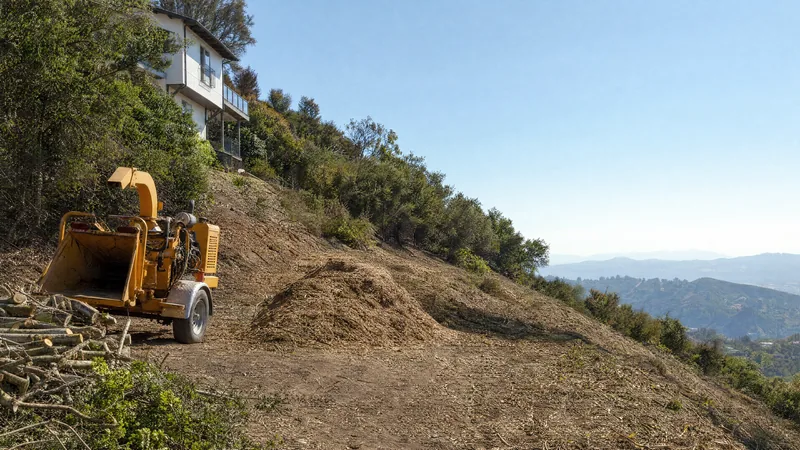
TinderSmart Tehama, run by the Resource Conservation District of Tehama County, offers Community Chipping: residents cut and stack the brush and an RCD crew chips it (call 530-727-1280). The RCD's grant-funded Defensible Space Assistance Program also sends conservation technicians to create the 100-foot buffer at no cost for eligible residents. That work covers material under 10 inches in diameter, leaves chips and firewood on site, doesn't remove stumps, and is available once every three years. The RCD warns that the wait for a site visit can be about 14 months after you apply.
- Fire Safe Council
- Tehama-Glenn Fire Safe Council
More
Tehama County's Fire Hazard Abatement Ordinance (Chapter 9.05, rewritten in 2022) makes vegetation that can carry fire a public nuisance on any unincorporated parcel that lacks the required firebreaks, and ties rural and improved lots to the state's 100-foot defensible space standard. It is enforced by the Tehama County Fire Department, which CAL FIRE's Tehama-Glenn Unit has run under a cooperative agreement since 1927, and by county code enforcement. Contractors below are ranked by public Google rating.

More in Tehama County 11
Serving all of California 8
Also on record 9
-
2c General Engineering
-
All In 1 Tree and Timber INC
-
Bamford/apex
-
BMF Forestry Consulting LLC
-
Bundy's Tree Service
-
Diversified Resources, Inc.
-
Evans Right of Way Clearing
-
Jefferson Resource Company
-
Wild West Reforesters INC
Defensible space rules in Tehama County
Fire hazard zones in Tehama County
Tehama County Fire’s service area covers about 2,958 square miles, from the Sacramento Valley to the Highway 36 corridor through Lassen National Forest. On March 18, 2025 the Board of Supervisors adopted Ordinance No. 2146, which designates the State Fire Marshal’s Moderate, High and Very High Fire Hazard Severity Zones in the unincorporated Local Responsibility Area. It took effect April 17, 2025, according to the county’s ordinance summary. Until then only Very High zones had to be adopted in the LRA. The fire department’s presentation to the Board counts about 17,808 acres Moderate, 21,030 acres High and 989 acres Very High in the county’s LRA. In High and Very High zones, new buildings must meet the state’s wildland-urban interface building code and home sellers must disclose the zone. Check a specific address on CAL FIRE’s FHSZ viewer.
Local rules and deadlines
Local rules are in the county’s Fire Hazard Abatement Ordinance, Chapter 9.05, which was rewritten in 2022. It treats weeds, grass, brush or trimmings that could spread fire as a public nuisance on any unincorporated parcel that doesn’t have the required firebreaks. Rural, agricultural and developed parcels follow the state’s 100-foot defensible space standard. Vacant urban-zoned lots have their own rules: small lots are cleared entirely, and larger lots next to homes need a 30-foot boundary firebreak. Tehama County Fire’s defensible space guide and inspection report lists what inspectors look for. Grass must be cut to 4 inches or less and trees trimmed 6 feet up from the ground. Shrubs must be spaced at least three times their widest diameter and kept 10 feet from buildings. Limbs must be cut back 10 feet from chimneys, and leaves and needles cleared from roofs and gutters. County inspectors did 938 defensible space inspections in the Local Responsibility Area in 2025, per the department’s annual report. Owners are liable for the county’s abatement and staff costs, and the county can withhold permits while a notice to abate goes unresolved. Fire protection in the unincorporated county is provided by the Tehama County Fire Department, which CAL FIRE’s Tehama-Glenn Unit has operated under a cooperative agreement since 1927.
Free chipping and fire-safe programs
TinderSmart Tehama is run by the RCD with its nonprofit, the Tehama Conservation Fund. It includes Community Chipping, where you cut and stack the brush and the RCD chips it. Its grant-funded Defensible Space Assistance Program sends crews to thin brush, limb branches and fell small trees at no cost, once every three years per home. Chips and firewood stay on the property, stumps are not removed, and the wait for a site visit can be about 14 months.
County resources
Start with the Chapter 9.05 ordinance text, the RCD’s TinderSmart Tehama programs, and the Tehama-Glenn Fire Safe Council, which the Tehama and Glenn County RCDs co-manage. The contractors listed below serve Tehama County and can help clear and maintain defensible space for homeowners who don’t want to wait for a grant-funded crew.
Frequently asked questions 6
Who enforces defensible space rules in Tehama County?
Chapter 9.05 lets the chief of the fire agency with jurisdiction, anyone that chief designates, or a county code enforcement officer enforce it. In the unincorporated county that fire agency is the Tehama County Fire Department, which CAL FIRE's Tehama-Glenn Unit has run under a cooperative agreement since 1927.
What exactly do inspectors check?
Tehama County Fire's inspection report asks for 100 feet of clearance around buildings or to the property line: grass cut to 4 inches or less, trees trimmed 6 feet above the ground, brush thinned, brush and debris piles removed, dead plants next to or over buildings removed, limbs cut back 10 feet from chimneys, and leaves and needles cleared from roofs, gutters and decks. In 2025 county fire safety inspectors did 938 defensible space inspections in the Local Responsibility Area, and CAL FIRE and the county together did 11,564 across the county.
What happens if I don't clear a fire hazard on my property?
The county can treat the hazard as a public nuisance and clear it through a nuisance-abatement process or a civil action. Whoever keeps the hazard is liable for the county's abatement and administrative costs and, in some cases, attorney's fees. If a notice to abate hasn't been dealt with within 14 days and wasn't appealed, county departments can refuse to issue permits for the property except for work needed to fix the problem.
How wide does my firebreak need to be?
On rural and agricultural land, and on urban-zoned parcels that have buildings or are larger than ten acres, the county applies the state standard in Public Resources Code 4291, which calls for 100 feet of defensible space around structures. Vacant urban lots of two acres or less must be cleared across the whole parcel. Vacant urban lots of two to ten acres next to developed parcels need a 30-foot firebreak along their property lines. The enforcing officer can set a modified standard for steep slopes or sensitive habitat.
How do I find out whether I'm in a high fire hazard zone?
Look up your address on CAL FIRE's Fire Hazard Severity Zone viewer. In March 2025 the county adopted the State Fire Marshal's new Local Responsibility Area map (Ordinance No. 2146), which rates land Moderate, High or Very High instead of marking only Very High zones, so a parcel may be zoned now even if it wasn't before. The county fire department says defensible space is already required countywide under Chapter 9.05, whatever the zone.
Can I get free help or chipping for defensible space in Tehama County?
Yes, through TinderSmart Tehama. The RCD's Community Chipping service chips brush that residents cut and stack themselves. The grant-funded Defensible Space Assistance Program also does clearing work at no cost for eligible residents, once every three years. Because it is grant-funded, service is intermittent, and the wait for a site visit can run about 14 months.