In short
In California practice, a "fire-resistant window" is usually just a dual-pane window with at least one tempered pane — the mainstream compliance path under §504.8 of the state's WUI code. Ordinary glass breaks under wildfire heat, and a broken window is an open hole in the wall. Replacement runs about $755.50 per 2-by-3-foot window plus $400 to $500 in trim and flashing, per the 2024 Headwaters Economics / CAL FIRE retrofit cost study.
Does your window pass §504.8?
Look at the glass, not the brand. Seen from above, outside on the left:
-
Single pane
Does not comply -
Dual pane, no tempered pane
Does not comply -
Dual pane, one tempered pane
Complies
Checking a line on the window order
- Frame material
- §504.8 doesn't ask
- Number of panes
- Multilayered — dual-pane
- Glass treatment
- At least 1 tempered pane
No special ordering: any competent window supplier can quote it.
How a window lets fire in
- Radiant heat No flame ever touches your wall
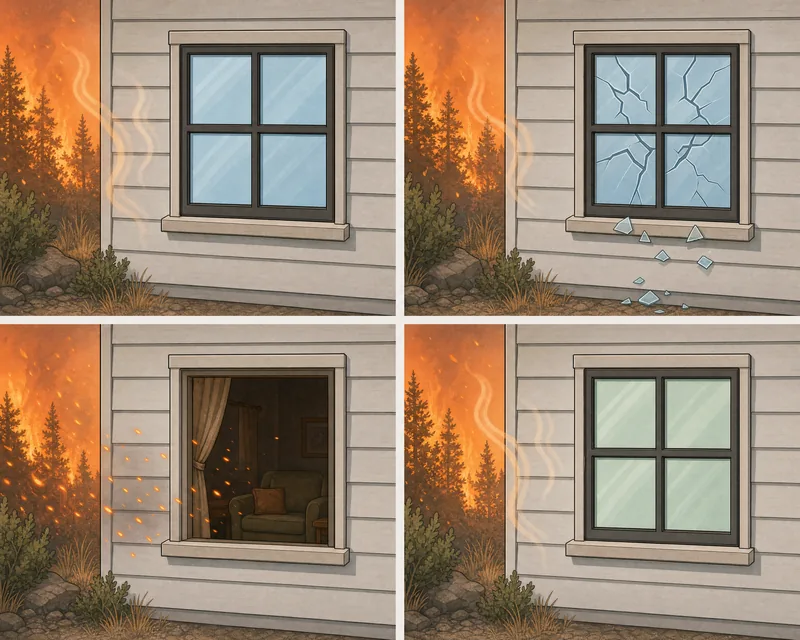
- Glass cracks and falls out Ordinary glass, from heat alone
- An open hole in the wall Embers reach curtains, furniture, carpet
- With one tempered layer Built “to withstand fire-induced breakage”
- Limit the size and number of windows facing large areas of vegetation
- Keep screens on operable windows to catch embers
Four ways to comply — one fits almost every house
CBC Chapter 7A §708A.2.1 CWUIC §504.8 since January 1, 2026
- 1
Multilayered glass, 1 tempered pane
Tempered glass per CBC Section 2406 The path essentially every house takes - 2
Glass block
- 3
20-minute fire-protection rating
Tested to NFPA 257 or UL 9 - 4
SFM Standard 12-7A-2
150 kW direct flame held for 8 minutes 1 listee statewide in OSFM Category 8120 — don’t go looking for an “OSFM-listed window”; check the glass spec instead.
Same rule covers
- Exterior windows
- Window walls
- Glazed doors
- Windows within exterior doors
- Skylights operable ones: mesh screen, openings ≤ 1/8 inch (§504.8.2)
Does it apply to your home?
-
Building new in a WUI area
RequiredOne of the four §504.8 options on every window, glazed door and skylight
-
Existing home
No retrofit mandateSingle-pane or non-tempered windows are not illegal
-
Selling in a high or very high fire hazard severity zone
Disclose“Single-pane or nontempered windows” is on the Civil Code §1102.6f list
-
Windows due for replacement
Upgrade thenCAL FIRE: at replacement, multi-paned with at least one pane of tempered glass
Additions and remodels of buildings originally built before July 1, 2008 are exempt. Local jurisdictions can amend the code — consult your local building official before ordering.
What one window costs
Double-paned, tempered-glass, metal-clad wood casement, 2 by 3 feet · 2024 Headwaters Economics / CAL FIRE study
- Window, installed
- $755.50
- Tape, flashing, trim
- $400–$500
- Per window
- $1,155–$1,255
Other openings, same 2024 study
- Metal storm window $333
- Tempered 2×3 ft window, installed $755.50
- Flat tempered-glass skylight $1,434.88
- Sliding door, metal frame, tempered insulated glass $2,681
- Same door, fiberglass frame $9,819
Protective noncombustible shutters: $46.78 per square foot. Treat the 2022 figures as order-of-magnitude, not quotes.
Why windows fail in a wildfire
The Office of the State Fire Marshal describes three ways a wildfire attacks a house: embers, direct flames, and radiant heat — the last being heat given off by nearby burning fuel or a neighboring structure, with no flame ever touching your wall. Glass is the part of the building envelope least able to shrug that off. Ordinary window glass can crack and fall out from heat exposure alone, which is exactly the failure CAL FIRE's home hardening guidance is aimed at when it tells homeowners to fit dual-paned windows with at least one tempered glass layer "to withstand fire-induced breakage."
The reason that matters is what happens next. Once the glass is gone, the opening behaves like a window somebody left open: embers and flame have an unobstructed path into a room full of curtains, furniture, and carpet — and ember entry is the dominant loss mechanism in these fires, with CAL FIRE estimating that between 60 and 90 percent of home ignitions occur because of embers. So a window is not only a thing that can burn; it is a potential doorway that opens by itself when the heat gets high enough.
CAL FIRE's hardening your home guidance adds two design points that go beyond the glass spec: limit the size and number of windows that face large areas of vegetation, and keep screens on operable windows to catch embers. Both are worth raising with an architect on a remodel, when the window layout is still on paper and changing it costs nothing.
What California code requires
The rules live in the 2025 California Wildland-Urban Interface Code (CWUIC, Title 24 Part 7), which replaced CBC Chapter 7A on January 1, 2026. If you are reading older contractor literature you will see this cited as Chapter 7A §708A.2.1; the same content is now CWUIC §504.8. It covers exterior windows, window walls, glazed doors, windows within exterior doors, and skylights, and it allows four ways to comply:
- Multilayered glazed panels with at least one pane of tempered glass complying with Section 2406 of the California Building Code.
- Glass block.
- Glazing with a fire-protection rating of not less than 20 minutes when tested according to NFPA 257 or UL 9.
- Glazing meeting the performance requirements of SFM Standard 12-7A-2 — a 150 kW direct flame exposure held for 8 minutes.
Plain English: option 1 is the path essentially every house takes. A standard dual-pane window with one tempered pane complies. A single-pane window does not, and neither does a dual-pane window with no tempered pane. That is the whole test for most projects — you are not shopping for an exotic product, you are checking a line on the window order.
Scope matters as much as the spec. The WUI code applies to new buildings in wildland-urban interface areas — State Responsibility Area land in a moderate, high, or very high fire hazard severity zone, Local Responsibility Area land designated very high (OSFM guidance also mentions high — the designation is local, so confirm with your building official), and locally designated WUI areas. Additions and remodels of buildings originally built before July 1, 2008 are exempt. Local jurisdictions can amend the code, so OSFM's own advice is to consult your local building official before ordering anything.
Two neighboring rules come up constantly on window jobs. Operable skylights need a noncombustible mesh screen with openings no larger than 1/8 inch (§504.8.2). And exterior doors (§504.9) must be noncombustible, or solid-core wood at least 1-3/4 inches thick, or carry a 20-minute rating, or use tested cladding; garage doors get their own detail — gaps at the bottom, sides, and top no wider than 1/8 inch (§504.9.2).
For an existing home there is no retrofit mandate, but there is a paperwork consequence. Under Civil Code §1102.6f, a seller in a high or very high fire hazard severity zone must disclose whether the house has certain features — and "single-pane or nontempered windows" is on that list, alongside items like vents with openings over 1/8 inch and untreated wood roof shingles. This is a disclosure duty, not a retrofit mandate: you may sell a house with single-pane windows, you simply have to say so. See our AB 38 guide for how that disclosure works at sale.
Tempered vs. annealed glass
This is where the shopping term "tempered glass windows" and the code term meet. Tempering is a property of the glass, not of the window unit — the frame material, the number of panes, and the glass treatment are three separate line items on a quote, and §504.8 speaks to the last two. Annealed glass is the ordinary, untreated product; tempered glass is what the code points to when it asks for a pane complying with CBC Section 2406, and what CAL FIRE points to when it asks for a layer that will withstand fire-induced breakage.
The cost gap is small, which is why this ended up as the mainstream code path rather than a premium upgrade. Per a 2022 Headwaters Economics / IBHS study of California construction costs, tempered glass was approximately $7 per square foot more expensive than annealed, and specifying both panes tempered cost approximately 15% to 18% more than annealed. The code only requires one tempered pane, so the cheaper configuration is also the compliant one. That same report is candid that its cost database was not detailed enough to price window options as precisely as other components — useful for sizing the decision, not for budgeting a specific order.
If you are searching for "tempered glass windows" because of a fire zone requirement, this section is the whole answer: you are being pointed at option 1 of §504.8, and any competent window supplier can quote a dual-pane unit with one tempered lite without special ordering.
What it costs
The best-sourced California numbers come from the 2024 Headwaters Economics / CAL FIRE retrofit cost study, which priced retrofits of existing California homes including material, labor, and demolition. Its window line item is a double-paned, tempered-glass, metal-clad wood casement measuring 2 by 3 feet:
- The window itself: about $755.50 each, installed — this figure does not include trim.
- Tape, flashing, and replacing and refinishing interior and exterior trim: about $400 to $500 per window.
- Realistic installed total: roughly $1,155 to $1,255 per 2-by-3-foot window, i.e. the sum of those two components.
- A typical short side of a home with two such windows: $2,200 to $2,500 total.
Related openings from the same 2024 study, if your project is bigger than glass alone: a metal-framed sliding door with tempered insulated glass ran $2,681 (the fiberglass-framed equivalent was $9,819), a metal storm window $333, and a flat tempered-glass skylight $1,434.88 each. Protective noncombustible shutters were priced at $46.78 per square foot — and the study also recorded quotes from California contractors putting shutters on four 2-by-4-foot windows plus one 8-by-10-foot door at around $8,900 total, a useful reminder that real-world bids and unit-cost tables are different animals. Full report: Headwaters Economics, Retrofitting a Home for Wildfire Resistance.
Timing is the lever that makes this affordable. CAL FIRE's official low-cost retrofit list (updated January 1, 2026) contains no prices at all — it frames windows as a replace-at-end-of-life item: "When it's time to replace your windows, replace them with multi-paned windows that have at least one pane of tempered glass." If your windows are already due, the wildfire-resistant version costs a modest premium over whatever you were going to buy anyway. Completed hardening work can also matter to your premium — see insurance discounts for how to document it.
OSFM listings for windows
Here is a fact worth knowing before a salesperson tells you otherwise. CAL FIRE's Office of the State Fire Marshal runs a Building Materials Listing (BML) program, and windows have their own category — Category 8120, Exterior Windows for WUI, tested to SFM Standard 12-7A-2. As of the September 2, 2025 edition of the OSFM WUI Listed Products Handbook, that category contains exactly one listee statewide: Riviera Bronze Manufacturing of Ventura, California, with two listings.
That is not a gap in the market — it is a consequence of how §504.8 is written. Three of the four compliance options are prescriptive descriptions of the glazing, so an ordinary dual-pane window with one tempered pane complies on its face without any listing. Category 8120 exists for products taking the fourth path, the 12-7A-2 performance test, and almost nobody needs it. Practical takeaway: do not go looking for an "OSFM-listed window" — check the glass spec instead.
You can verify any listing yourself in the OSFM BML search tool. Two caveats OSFM states in the handbook itself: products that are not listed may still comply with the prescriptive standards, and the local Authority Having Jurisdiction has the right to approve or disapprove products in its own jurisdiction. Brand names above are examples of current listings, not recommendations.
Related retrofits: ember-resistant vents · Class A roofs · fire-resistant siding · home hardening contractors
FAQ
5
Do fire-resistant windows have to be "fire-rated"?
No. Fire-protection-rated glazing (a rating of not less than 20 minutes, tested to NFPA 257 or UL 9) is only one of four options the California WUI Code allows under §504.8. The other three are multilayered glazed panels with at least one pane of tempered glass, glass block, and glazing that meets the performance requirements of SFM Standard 12-7A-2. In everyday practice almost every California home takes the first path — an ordinary dual-pane window that has one tempered pane — so the phrase "fire-rated window" overstates what most homeowners actually need to buy.
Is tempered glass required by law in California fire zones?
For new buildings inside a wildland-urban interface area, yes in effect: §504.8 of the 2025 California WUI Code requires one of four glazing options, and the tempered-pane option is the one virtually all residential windows use. The requirement attaches to new construction, not to windows already in your house. Existing single-pane or non-tempered windows are not illegal and there is no state order to replace them — but they are one of the home features a seller must disclose in a high or very high fire hazard severity zone under Civil Code §1102.6f.
How much more does tempered glass cost than annealed?
Per a 2022 Headwaters Economics / IBHS study of California construction costs, tempered glass ran approximately $7 per square foot more than annealed glass, and having both panes tempered cost approximately 15% to 18% more than annealed. The same report cautions that its cost data source did not provide detailed enough information to price window options precisely, so treat these as order-of-magnitude figures rather than quotes. Note also that the code only asks for at least one tempered pane, so the cheaper single-tempered configuration is the compliant one.
Do I have to replace the windows on my existing home?
No. The California WUI Code applies to new buildings in WUI areas; the one place it reaches back to existing homes by force is roofing (§507, triggered when you replace 50 percent or more of a roof covering in 12 months). There is no equivalent retroactive trigger for windows. CAL FIRE's official low-cost retrofit list frames it as a replacement-time upgrade: "When it's time to replace your windows, replace them with multi-paned windows that have at least one pane of tempered glass."
What about skylights and glazed doors?
Skylights are covered by the same section as windows — §504.8 names exterior windows, window walls, glazed doors, windows within exterior doors, and skylights together, so the same four glazing options apply. Operable skylights get one extra requirement under §504.8.2: a noncombustible mesh screen with openings no larger than 1/8 inch. Doors themselves fall under §504.9, and any glass set into a door is sent back to §504.8 for the glazing spec.
Sources 7
- hardening your home readyforwildfire.org
- CWUIC §504.8 codes.iccsafe.org
- consult your local building official osfm.fire.ca.gov
- Civil Code §1102.6f leginfo.legislature.ca.gov
- Headwaters Economics, Retrofitting a Home for Wildfire Resistance headwaterseconomics.org
- low-cost retrofit list caloes.ca.gov
- BML search tool calfire.govmotus.org
Find home hardening contractors in your county
- Alameda44
- Alpine3
- Amador16
- Butte60
- Calaveras23
- Colusa4
- Contra Costa52
- Del Norte1
- El Dorado75
- Fresno16
- Glenn7
- Humboldt15
- Imperial5
- Inyo4
- Kern19
- Kings4
- Lake18
- Lassen7
- Los Angeles282
- Madera10
- Marin75
- Mariposa4
- Mendocino34
- Merced9
- Modoc3
- Mono5
- Monterey24
- Napa44
- Nevada97
- Orange49
- Placer86
- Plumas11
- Riverside64
- Sacramento41
- San Benito6
- San Bernardino41
- San Diego67
- San Francisco9
- San Joaquin18
- San Luis Obispo16
- San Mateo32
- Santa Barbara30
- Santa Clara49
- Santa Cruz33
- Shasta41
- Sierra5
- Siskiyou10
- Solano13
- Sonoma107
- Stanislaus16
- Sutter7
- Tehama21
- Trinity5
- Tulare17
- Tuolumne19
- Ventura34
- Yolo12
- Yuba12
 Ember-resistant vents
  Class A roof
  Fire-resistant siding
  AB-38: selling a home